AI AGENTS SQL
Democratizing data access in your company for faster decision-making?
Companies like Uber, LinkedIn, and Salesforce are leveraging SQL agents to eliminate bottlenecks and democratize access to business information.
Introduction
Before reading further, it’s worth understanding what SQL agents are and why they’re transforming the way we interact with databases..
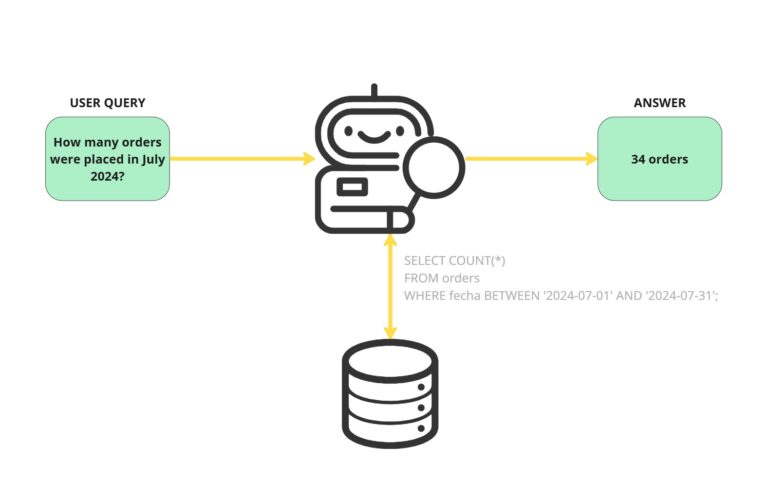
In simple terms, an SQL agent is an AI system that is given context about a database (its structure, tables, relationships, etc.) and granted access to it. With this knowledge and access, the agent can interpret natural language questions, automatically translate them into valid SQL queries, execute those queries, interpret the results, and respond to the user.
Let’s say you work at an e-commerce company with a database containing tables like customers, orders, and products. If you wanted to know, “How many orders were placed in July 2024?”, you'd typically have to write a query like:
SELECT COUNT(*)
FROM pedidos
WHERE fecha BETWEEN ‘2024-07-01’ AND ‘2024-07-31’;
With a SQL agent, you could simply:
- Type in natural language: “How many orders were there in July 2024?”
- The agent interprets your question
- Generates the correct SQL query
- Executes it and returns the answer
All of this without writing a single line of SQL.
THE PROBLEM
Companies often rely on technical teams as intermediaries to answer simple or complex questions about business data stored in databases. This leads to bottlenecks, delays, and frequently, decisions based on outdated or incomplete information.
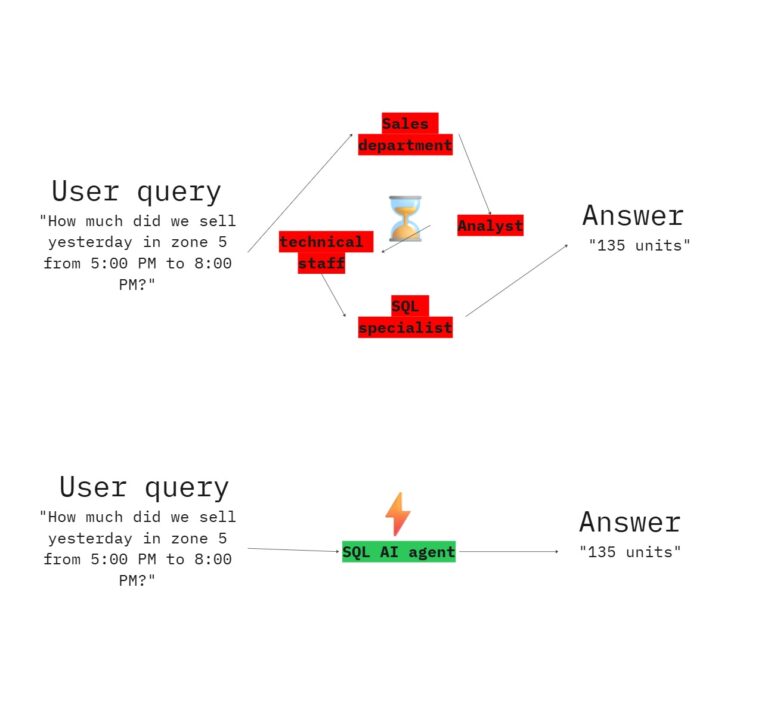
Technical dependency as a bottleneck
Companies often rely on technical teams as intermediaries to answer simple or complex questions about business data stored in databases. This leads to bottlenecks, delays, and frequently, decisions based on outdated or incomplete information.
This technical dependence creates several issues:
–Delays in critical decisions: Waiting hours or days for answers can cost valuable opportunities.
Operational inefficiencies: Technical teams spend time on repetitive queries instead of strategic projects.
Limited data-driven culture: When access is hard, people ask fewer questions leaving key insights unexplored.
What if everyone in your organization could access data directly, just by asking questions in plain language, via WhatsApp, Slack, or Telegram?
REAL WORLD SUCCES STORIES
LinkedIn: Their SQL Bot enables hundreds of employees to get business insights within seconds directly through their internal platform, removing technical barriers altogether. Link to blog post
Uber: Using QueryGPT and Finch, Uber has drastically reduced the time to write complex SQL queries from 10 minutes to just 3 boosting both productivity and accuracy in financial and operational analysis. Link to blog post
Swiggy: With Hermes, employees can query data instantly via Slack, enabling faster and more precise decisions without external analyst support. Link to blog post
Salesforce: Their Horizon Agent allows internal users to retrieve operational and financial insights directly in Slack, without relying on engineers. Link to blog post
Savian.ai: Savian, a company focused on bringing cutting-edge technology to the agricultural sector, has partnered with us to implement an SQL agent that allows managers and greenhouse operators to monitor the status of their greenhouses in real time, directly from WhatsApp..
A KEY DETAILS
To function efficiently in a business environment, these agents must integrate several critical elements:
- Conversational interface integration: Successful agents work directly within familiar platforms like Slack, Teams, or internal apps, ensuring high adoption and ease of use.
Context-enriched architecture for large databases: When dealing with vast datasets, an LLM + RAG (Retrieval-Augmented Generation) architecture is the optimal setup. It allows the agent to understand specific schema and metadata, enhancing query precision.
– Multi-agent systems with self-correction:To prevent production errors, agents are often composed of sub-agents that generate, validate, correct, and optimize SQL queries before execution ensuring reliable responses.
– Built-in security, permissions, and governance: Advanced agents like Finch (Uber) and SQL Bot (LinkedIn) respect existing permission models, ensuring users only access authorized data.
– Continuous validation and feedback:Agent quality is maintained through ongoing monitoring, fine-tuning, and user feedback. At Ideasforge, for example, we run weekly tests with consistent questions to detect LLM performance degradation and hallucinations early.
CONCLUSION
Thanks to recent advancements in language models (LLMs), what once seemed impossible is now a reality: building agents capable of generating accurate SQL queries from natural language, autonomously and reliably.
This opens a new era in data access, removing technical dependency and enabling faster, insight-driven decisions.
Companies like LinkedIn, Uber, and Salesforce are already reaping the benefits. The technology is ready. The competitive edge now belongs to whoever implements it first.

What's next?
If you have a similar idea you'd like to implement in your company, feel free to reach out. You can contact me at pablo@ideasforge.io